More Distractions of Sand and Surf
I had just enough energy after staggering home from 17P-4 to copy the photographs from the camera's card to the computer. Oh... look at that. The new lens has lovely color rendition and great sharpness.
Sand photographs taken the next day show that it is distinctly better than the old lens. Venice fine sand actually has shape and texture now.
By Wednesday I'm ready to try another sculpture. This time I'll take the cart and some tools. Mussel shells are beautiful and carve better than a plain finger, but purpose-made tools are better yet.
It's a reprise of the Friday attempt, even if the surf isn't quite that big. Coarse sand dragged down, big waves pushing high. I pretty much bag the sculpture idea and simply sit behind the Breakwater and watch the play of color and sunlight backlighting the confusion of waves breaking against and reflecting from the rocks. Shades of turquoise and aqua I've never seen rise in split-second curves and splatters. They'd make great photographs, if I wanted to make the effort and distract myself with machinery.
Instead I just watch for a while, and then walk home.
Two days later I head for the beach again. Waves seem reasonable and the air is cool, but there's a strong wind playing among the buildings. I don't see any blowing sand over the beach so I continue the walk.
I'm early. Again, I sit behind the Breakwater and watch the waves. Sparkling under the sun, blown by the west wind that lifts whitecaps and splatters me with salt.
After a time water no longer crosses the storm drain. I head back to the build site and start piling after one wave pushes up just to remind me that the ocean is doing me a favor here. No more waves come close..
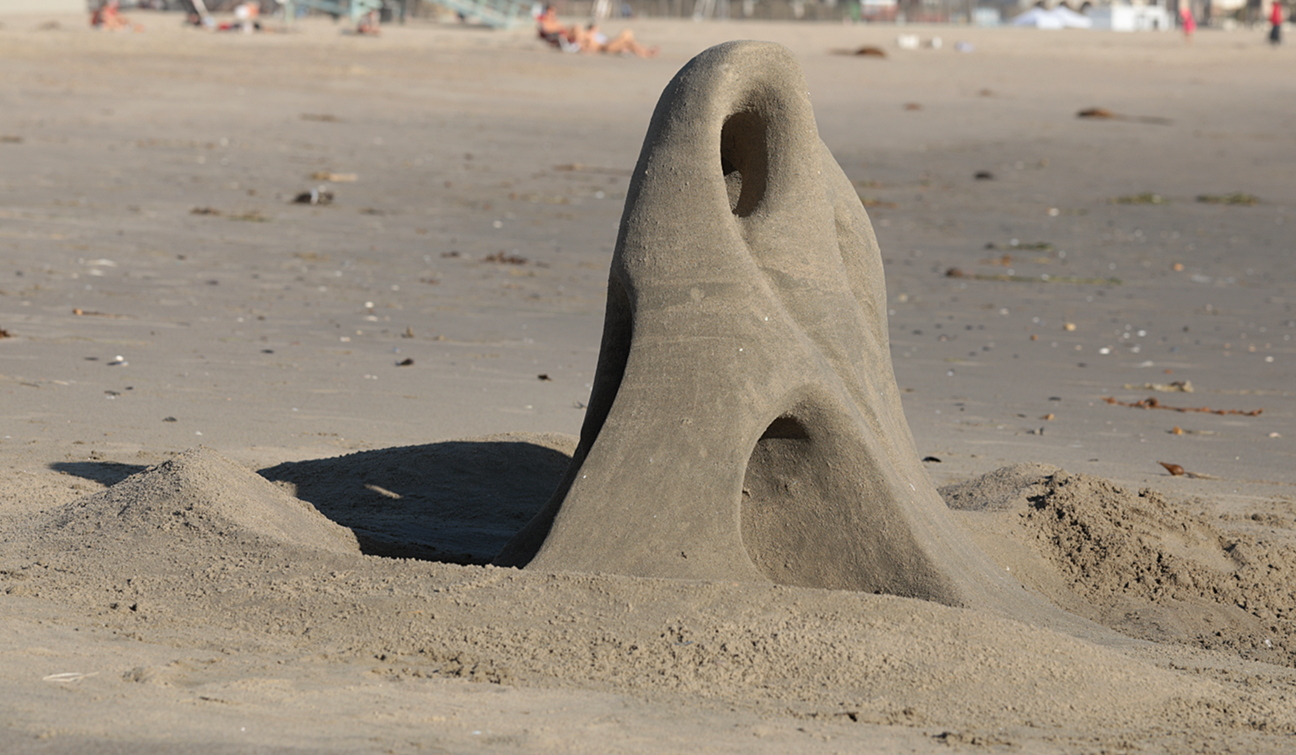
Build number: 17P-5 (monolith with earthworks)
Title: none
Date: October 20
Location: Venice Breakwater, south side littoral
Start: 12:00, construction time approx. 3.25 hours
Size: about 24 inches tall, 30 inches wide, 18 inches deep (less earthworks)
Digital Images: EOS 5D Mk IV, 100mm L macro, tripod; 50mm macro handheld
New Tools: none
New Equipment: none
I made the base very big because the beach is still wet. It tapers rapidly and then the real piling begins. Free-piling has some natural limits based on the sand; this sand, with its high proportion of coarse material, drains faster. That means I have less time to add each new layer. Pack fast, pack smaller.
Still, there's enough for this short day. The shape suggests some carved forms. I modify them away from the easy defaults. Think and feel. How can this part fit with that part?
With real tools it's really easy to get out of control. The sun moves slowly. There is time to think and feel before cutting, and cut lightly so as to leave room for details and subtle shapes.
The lower third remains very wet. I'd like to hollow it out but there's no real need and the sand isn't all that stable.
I dig some hollows into the beach and add that to the waste sand earthworks. Some curves continue, some stop abruptly. Contrasts and shadows and edges.
It could use more work, and there's time, but I miscalculated the water balance and really need to go. Hunger is assuaged with a chia bar but only a pit stop will solve the water problem, so I do the photography and bail. Too bad... the shadows and light were becoming interesting.
No balls this time. The sculpture is strong enough, and well enough shaped, to stand alone in its shaped environment.
The main photographic record is shot with the 100mm L lens, camera on the tripod. Then I do a round with the 50mm macro handheld from a higher angle as this shows some details better than the low-angle shots. Unfortunately, I forgot to set the lens to auto-focus and can't see anything in the viewfinder due to salt on my glasses. All of the 50mm photos are blurry.
Santa Monica
2017 October 21
October 2-9 tide window:
October 2: 17P-2 on photo walk and sampling. No tools.
October 4: 17P-3 planned sculpture walk with cart, camera, tools
October 6: Started a planned free-pile multiple, but washed out by huge surf
October 15-22 tide window:
October 16: 17P-4, photo walk for sampling, sculpt with shells
October 18: Plan sculpture, walk to beach with kit but big, strong surf cancels start
October 20: 17P-5, planned, delayed by strong surf
This simplified design presents all of my sculptures made from the year 2010 and forward. It also includes other sculpture-related projects, such as sand macrophotography. The "Blog Archive" sidebar gives you access to all the articles here.
Friday, October 20, 2017
Monday, October 16, 2017
17P-4 (October 16)
Distractions of Sand and Surf
The tide window was still open on the Friday following 17P-4, so I anticipated making a multiple with earthworks, and loaded appropriate equipment into the cart. As soon as I came within sight of the beach I knew that plan was threatened: I could see the spray from breaking waves above the high-tide cusp. That should have been hidden at this point in the tide.
The day was hot. Little wind, many people. I continued to the Breakwater anyway, hoping. Hope was dashed by the combination of waves being driven far up the beach by the huge surf that hammered the Breakwater and pushed spray high into the sky, and the coarse sand dragged down by the retreating water. Under the coarse sand was fine, so I started a pile but abandoned the effort when a big wave filled the borrow pit. And that was it for the tide window. What to call this effort? Maybe 17A-1 for "attempt," or 17PA1 for "free-pile attempt." It doesn't happen often.
I spent the next week photographing sand and pebbles. These are lovely when seen up close in detail. I began to suspect I could do better than the old 100mm macro lens I'd bought in 2005; it did well for sand of about 250 microns and up, but the very fine Venice sand always came out blurry no matter how careful I was. I decided to take a chance and buy the more expensive L version of the 100mm macro.
I got home from that errand in time to go to the beach for low-tide still life photography. I unpacked the new lens, put it into the kit bag and walked to the Breakwater.
There were some nice still life subjects revealed by the low tide and relaxed surf.
Also revealed was good sand.
Build number: 17P-4 (monolith with earthworks and balls)
Title: none
Date: October 16
Location: Venice Breakwater, south side littoral
Start: 12:00, construction time approx. 3 hours
Size: about 22 inches tall, 24 inches wide, 18 inches deep (less earthworks)
Digital Images: EOS 5D Mk IV, 100mm L macro, tripod; 50mm macro handheld
New Tools: none
New Equipment: Canon EF 100mm F/2.8L macro lens
I had only photographic tools with me. Some scavenging produced a big clam shell and some mussels for carving. Those and fingers would do.
The sand was in layers fine and coarse, which mixed as I packed. Quite strong. Not much on my mind as I did this but the simple fact of being there and carving, shaping with fingers, trying to figure out how to get a hand with a mussel edge into a small space and do some carving without pushing it apart.
Earthworks make for more interesting photographs, at this time of year when long shadows show the relief. I retained the waste sand in heaps for the later earthworks.
And, when done, the borrow pit was still wet enough to get sopping sand. I picked up a double handful and made a ball. A big ball. Another one almost as big went on top of that, and a third for balance off at the far end of the earthworks. The big stack was nearly too big, at about half the height of the sculpture itself.
Santa Monica
2017 October 21
The tide window was still open on the Friday following 17P-4, so I anticipated making a multiple with earthworks, and loaded appropriate equipment into the cart. As soon as I came within sight of the beach I knew that plan was threatened: I could see the spray from breaking waves above the high-tide cusp. That should have been hidden at this point in the tide.
The day was hot. Little wind, many people. I continued to the Breakwater anyway, hoping. Hope was dashed by the combination of waves being driven far up the beach by the huge surf that hammered the Breakwater and pushed spray high into the sky, and the coarse sand dragged down by the retreating water. Under the coarse sand was fine, so I started a pile but abandoned the effort when a big wave filled the borrow pit. And that was it for the tide window. What to call this effort? Maybe 17A-1 for "attempt," or 17PA1 for "free-pile attempt." It doesn't happen often.
I spent the next week photographing sand and pebbles. These are lovely when seen up close in detail. I began to suspect I could do better than the old 100mm macro lens I'd bought in 2005; it did well for sand of about 250 microns and up, but the very fine Venice sand always came out blurry no matter how careful I was. I decided to take a chance and buy the more expensive L version of the 100mm macro.
I got home from that errand in time to go to the beach for low-tide still life photography. I unpacked the new lens, put it into the kit bag and walked to the Breakwater.
There were some nice still life subjects revealed by the low tide and relaxed surf.
Also revealed was good sand.
Build number: 17P-4 (monolith with earthworks and balls)
Title: none
Date: October 16
Location: Venice Breakwater, south side littoral
Start: 12:00, construction time approx. 3 hours
Size: about 22 inches tall, 24 inches wide, 18 inches deep (less earthworks)
Digital Images: EOS 5D Mk IV, 100mm L macro, tripod; 50mm macro handheld
New Tools: none
New Equipment: Canon EF 100mm F/2.8L macro lens
I had only photographic tools with me. Some scavenging produced a big clam shell and some mussels for carving. Those and fingers would do.
The sand was in layers fine and coarse, which mixed as I packed. Quite strong. Not much on my mind as I did this but the simple fact of being there and carving, shaping with fingers, trying to figure out how to get a hand with a mussel edge into a small space and do some carving without pushing it apart.
Earthworks make for more interesting photographs, at this time of year when long shadows show the relief. I retained the waste sand in heaps for the later earthworks.
And, when done, the borrow pit was still wet enough to get sopping sand. I picked up a double handful and made a ball. A big ball. Another one almost as big went on top of that, and a third for balance off at the far end of the earthworks. The big stack was nearly too big, at about half the height of the sculpture itself.
Santa Monica
2017 October 21
Wednesday, October 4, 2017
17P-3, "Sensual Space" (October 4)
Perhaps differentiating "tail" from "dog" is an artificial concept. Certainly, if you asked the dog (the tail can't speak for itself), it would probably not get into a philosophical argument. "I," the dog says, "bark. The tail is along for the ride." Dogs do balance rather than talk about it.
I do sculpture. I do photography. I do photography of sculpture because people want me to, and it's not too onerous a task, and--eventually--I came to appreciate having a visual record. Visual records led to verbal records and the Web allowed merging the two expressions into one.
Photobucket's deplorable change in operations caused much of the record here to disintegrate. I'll have to address that someday. Fortunately, Blogger now does its own photo hosting so recent posts are still integrated. I don't know if anyone else uses this resource but I do, because it can be read from anywhere.
It is, however, a static display. I add to it. Older entries don't change. The technique for presenting sculptures here is settled and well polished.
In Second Life, sculpture presentations are in a pioneering era. The capability to show static images came about earlier this year, and I set up a gallery on a beach made for the purpose. A month or so later, a friend of mine gave me a display into which I can load my photographs and have a slide show. Its square display works well for many photographs.
For sand sculpture, however, the square often doesn't fit. Few of my sculptures are square in profile, and I frame them tightly in the photograph (a holdover from the days of limited number of pixels). So, I told people that a sand sculpture show was a good idea, but I was still working on the technical aspects.
Then my friend moved the state of the art into another zone. The new image display is big and rectangular, and shows 6 images at once. The six can be parts of one big image, or six separate images (such as flower close-ups), or any combination that fits within the 3X2 mosaic. I at first thought this would be reserved for special shows but it soon became the imager of choice for everything. It can be adapted to just about any subject, meaning that my sculptures of varies sizes, proportions and shapes can be accommodated.
Is the imager a tail, or a dog? What is sculpture, then? The question came up this day on the beach, when I deliberately added earthworks and balls to this sculpture--something I hadn't done in years--to make for a more interesting horizontal composition arranged for the imager. And as soon as I got home, I edited an image to suit. We have a Thursday "Show and Tell" session, you see.
Senses!
I remembered the shading of the surfaces on Monday's sculpture. The feel of the sand, subtly smoothing away the bumps and ridges left by rough carving. Free-piled sand is more plastic and it rubs away less smoothly.
So, I planned this one. I even brought some water. Tools, too, that hold up better than mussel shells.
Build number: 17P-3 (monolith with earthworks and balls)
Title: "Sensual Space"
Date: October 4
Location: Venice Breakwater, south side littoral
Start: 12:00, construction time approx. 3.5 hours
Size: about 24 inches tall, 28 inches wide, 18 inches deep
Digital Images: EOS 5D Mk IV, 100mm macro, tripod and handheld
New Tools: none
New Equipment: none
This one started out somewhat bigger, and became a little taller. It also developed an alarming lean to the north. It's well packed, and good sand. It takes a smooth surface once the outer layer of sand is gone.
There's time to carve some details in the curves. I can't do thin sections because there are lots of shells and fragments in the sand. But I can make it balanced.
This time I deliberately retain the waste sand to use in earthworks, which I build up in a curving berm around the east end. It seems to want more. The sand in the borrow pit is still wet so I pick up some and make a Venice snowball. It requires dry sand from higher on the beach to firm it up. That one invites another and it becomes a stack of two. There's another subtle point on the earthworks that calls for a third, smaller ball.
How much of this is for photography? I've learned a few things in dealing with the images for the Second Life show. One is that my image display is horizontal, so I have to use multiple images to fill the space, or shoot some horizontal format photographs. The balls and earlthworks will spread this one out and make at least one good landscape.
It still works for itself, making a more interesting base without being too distracting. I believe that earthworks should be in proportion to the sculpture itself but that assumption, like many others, is kind of blowing in the breeze of change. Try something and see what happens.
By the end of the day I'm thrashed and very glad to have the tripod with me. I can take my time setting up and pointing the camera, and not think about holding it steady while pointing in the right direction.
Going home is more of a slow stagger. At least it's cool. And the tide window will still be open Friday!
Santa Monica
2017 October 5
I do sculpture. I do photography. I do photography of sculpture because people want me to, and it's not too onerous a task, and--eventually--I came to appreciate having a visual record. Visual records led to verbal records and the Web allowed merging the two expressions into one.
Photobucket's deplorable change in operations caused much of the record here to disintegrate. I'll have to address that someday. Fortunately, Blogger now does its own photo hosting so recent posts are still integrated. I don't know if anyone else uses this resource but I do, because it can be read from anywhere.
It is, however, a static display. I add to it. Older entries don't change. The technique for presenting sculptures here is settled and well polished.
In Second Life, sculpture presentations are in a pioneering era. The capability to show static images came about earlier this year, and I set up a gallery on a beach made for the purpose. A month or so later, a friend of mine gave me a display into which I can load my photographs and have a slide show. Its square display works well for many photographs.
For sand sculpture, however, the square often doesn't fit. Few of my sculptures are square in profile, and I frame them tightly in the photograph (a holdover from the days of limited number of pixels). So, I told people that a sand sculpture show was a good idea, but I was still working on the technical aspects.
Then my friend moved the state of the art into another zone. The new image display is big and rectangular, and shows 6 images at once. The six can be parts of one big image, or six separate images (such as flower close-ups), or any combination that fits within the 3X2 mosaic. I at first thought this would be reserved for special shows but it soon became the imager of choice for everything. It can be adapted to just about any subject, meaning that my sculptures of varies sizes, proportions and shapes can be accommodated.
Is the imager a tail, or a dog? What is sculpture, then? The question came up this day on the beach, when I deliberately added earthworks and balls to this sculpture--something I hadn't done in years--to make for a more interesting horizontal composition arranged for the imager. And as soon as I got home, I edited an image to suit. We have a Thursday "Show and Tell" session, you see.
Click on the images to enlarge.
Senses!
I remembered the shading of the surfaces on Monday's sculpture. The feel of the sand, subtly smoothing away the bumps and ridges left by rough carving. Free-piled sand is more plastic and it rubs away less smoothly.
So, I planned this one. I even brought some water. Tools, too, that hold up better than mussel shells.
Build number: 17P-3 (monolith with earthworks and balls)
Title: "Sensual Space"
Date: October 4
Location: Venice Breakwater, south side littoral
Start: 12:00, construction time approx. 3.5 hours
Size: about 24 inches tall, 28 inches wide, 18 inches deep
Digital Images: EOS 5D Mk IV, 100mm macro, tripod and handheld
New Tools: none
New Equipment: none
This one started out somewhat bigger, and became a little taller. It also developed an alarming lean to the north. It's well packed, and good sand. It takes a smooth surface once the outer layer of sand is gone.
There's time to carve some details in the curves. I can't do thin sections because there are lots of shells and fragments in the sand. But I can make it balanced.
This time I deliberately retain the waste sand to use in earthworks, which I build up in a curving berm around the east end. It seems to want more. The sand in the borrow pit is still wet so I pick up some and make a Venice snowball. It requires dry sand from higher on the beach to firm it up. That one invites another and it becomes a stack of two. There's another subtle point on the earthworks that calls for a third, smaller ball.
How much of this is for photography? I've learned a few things in dealing with the images for the Second Life show. One is that my image display is horizontal, so I have to use multiple images to fill the space, or shoot some horizontal format photographs. The balls and earlthworks will spread this one out and make at least one good landscape.
It still works for itself, making a more interesting base without being too distracting. I believe that earthworks should be in proportion to the sculpture itself but that assumption, like many others, is kind of blowing in the breeze of change. Try something and see what happens.
By the end of the day I'm thrashed and very glad to have the tripod with me. I can take my time setting up and pointing the camera, and not think about holding it steady while pointing in the right direction.
Going home is more of a slow stagger. At least it's cool. And the tide window will still be open Friday!
Santa Monica
2017 October 5
Monday, October 2, 2017
17P-2, "Etude, Op. 341e (Surfaces Remusselled)" October 2
Summer crowds were pretty much gone, sun was high, tide was low. Wanting to do some photography of beach still life arranged by retreating waves, I shouldered the camera kit, picked up the tripod and headed for Venice.
I'd been pretty well concentrated on sand and events in Second Life. Sculpture ideas were still around but playing second, or third, fiddle to the sand itself. Sand actually had the last word, however. When I got to the beach I saw a huge expanse of creamy fine sand. Thoughts of photography promptly took the back seat and I went looking for some mussel shells to use in carving.
And You're Surprised?
I'd become so fascinated by pebbles, sand and seaweed patterns that sand sculpture faded into the background. The summer crowds are gone and the beach is a more attractive place to be. Thinking about those lovely seagrass curls, I walked to Venice Beach with my camera and tripod in hand. When I got there the expanse of fine sand drove all other thoughts out of my head; I found some mussel shells and started building a pile. After four years I still remembered how.
Build number: 17P-2 (monolith with low earthworks)
Title: "Etude, op. 341e (Surfaces Reconsidered)"
Date: October 2
Location: Venice Breakwater, south side littoral
Start: 1130, construction time approx. 3 hours
Size: about 22 inches tall, 20 inches wide, 14 inches deep
Digital Images: EOS 5D Mk IV, 100mm macro, tripod
New Tools: none
New Equipment: none
The basics are simple but there are details that help make a better pile, such as keeping the top flat and level, and using an arm to retain the sand while patting it to settle. It's a very intense physical process and I wondered if I'd hold up. Formed sculpture is as much work but with lower intensity. By the time I had the pile tall enough I was glad it was tall enough.
"A bad worker blames his tools." Mussel shells are fragile. I used my as carefully as I could. Years ago I didn't get compaction this good in free-piled sculpture. Now the shells don't last long, especially when I hit a shell hidden in the sand.
Fingers don't do much on sand that's packed well. So, everything has to be of a scale that a shell can get into. No fine details, but big smooth surfaces are fine. One basic opening, and some outer details.
I've been working on a sand sculpture show in Second Life. For this I've gone back and found more sculpture images, and I've had to look at them closely to determine which to use in the show. I've read the reports too. One thing comes out regularly: how negative I was about the multiple sculptures.
Now, with some years' remove, I can see more clearly. Yes, the sculptures are simpler and tend to be heavy. Trying to carve three state-of-the-art sculptures in one day, especially after packing three piles, is a lot to ask. The best multiples I made all had help and/or more time in a contest setting. Solo efforts showed some interesting ideas that had not enough time and energy to develop.
I also didn't photograph them effectively. Instead of shooting the ensemble as a whole, I closed in on each element. The very few ensemble shots I took show a lot of promise, especially when working with terrain features that meant I could do less work.
So, I was thinking about all of that while carving today. I had lots of waste sand lying around. I shaped that into earthworks around the sculpture's base. Not really enough, but still gave the immediate surroundings more texture.
I've been too disciplined in my approach to polishing the various factors of sand sculpture. Learning is essential. It's also supposed to be enjoyable to make all that work worthwhile. Too few rewards in recent years. This one is a nice change, and the tide window will remain open through the rest of the week.
Santa Monica
2017 October 5
I'd been pretty well concentrated on sand and events in Second Life. Sculpture ideas were still around but playing second, or third, fiddle to the sand itself. Sand actually had the last word, however. When I got to the beach I saw a huge expanse of creamy fine sand. Thoughts of photography promptly took the back seat and I went looking for some mussel shells to use in carving.
Click the images to enlarge
And You're Surprised?
I'd become so fascinated by pebbles, sand and seaweed patterns that sand sculpture faded into the background. The summer crowds are gone and the beach is a more attractive place to be. Thinking about those lovely seagrass curls, I walked to Venice Beach with my camera and tripod in hand. When I got there the expanse of fine sand drove all other thoughts out of my head; I found some mussel shells and started building a pile. After four years I still remembered how.
Build number: 17P-2 (monolith with low earthworks)
Title: "Etude, op. 341e (Surfaces Reconsidered)"
Date: October 2
Location: Venice Breakwater, south side littoral
Start: 1130, construction time approx. 3 hours
Size: about 22 inches tall, 20 inches wide, 14 inches deep
Digital Images: EOS 5D Mk IV, 100mm macro, tripod
New Tools: none
New Equipment: none
The basics are simple but there are details that help make a better pile, such as keeping the top flat and level, and using an arm to retain the sand while patting it to settle. It's a very intense physical process and I wondered if I'd hold up. Formed sculpture is as much work but with lower intensity. By the time I had the pile tall enough I was glad it was tall enough.
"A bad worker blames his tools." Mussel shells are fragile. I used my as carefully as I could. Years ago I didn't get compaction this good in free-piled sculpture. Now the shells don't last long, especially when I hit a shell hidden in the sand.
Fingers don't do much on sand that's packed well. So, everything has to be of a scale that a shell can get into. No fine details, but big smooth surfaces are fine. One basic opening, and some outer details.
I've been working on a sand sculpture show in Second Life. For this I've gone back and found more sculpture images, and I've had to look at them closely to determine which to use in the show. I've read the reports too. One thing comes out regularly: how negative I was about the multiple sculptures.
Now, with some years' remove, I can see more clearly. Yes, the sculptures are simpler and tend to be heavy. Trying to carve three state-of-the-art sculptures in one day, especially after packing three piles, is a lot to ask. The best multiples I made all had help and/or more time in a contest setting. Solo efforts showed some interesting ideas that had not enough time and energy to develop.
I also didn't photograph them effectively. Instead of shooting the ensemble as a whole, I closed in on each element. The very few ensemble shots I took show a lot of promise, especially when working with terrain features that meant I could do less work.
So, I was thinking about all of that while carving today. I had lots of waste sand lying around. I shaped that into earthworks around the sculpture's base. Not really enough, but still gave the immediate surroundings more texture.
I've been too disciplined in my approach to polishing the various factors of sand sculpture. Learning is essential. It's also supposed to be enjoyable to make all that work worthwhile. Too few rewards in recent years. This one is a nice change, and the tide window will remain open through the rest of the week.
Santa Monica
2017 October 5
Sunday, July 2, 2017
17F-2, "Etude, op. 344, (Spaces)" (June 28)
Click on the images to view them full size
The report follows the images
Summer Sculpture
The early morning is calm, quiet and cool under low clouds. I go a block and a half through the damp air, then return to get the monopod. It helped the last time in taming Sculptor's Palsy.
The summer day will be long. There's no need to start this early but to catch the low tide. I'd prefer an afternoon-to-sunset sculpture because the light is better for photography. The tide is right now and the sand is good. So, I make my way to the beach and walk out onto the broad expanse of dark and smooth sand.
Build number: 17F-2 (lifetime start #344); monolith on low riser
Title: "Etude, op. 344, (Spaces)"
Date: June 28
Location: Venice Breakwater, isthmus
Start: 0715, construction time approx. 6.5 hours
Size: about 41 inches tall, 21 inches diameter
Technique: Latchform, Box Filter 2, four full loads intertidal sand
Digital Images: 28, EOS-5D Mk IV and 85mm F/1.8, with RRS monopod (safeties and completed)
Volunteer photography: Larry Dudock, hand-held process and complete, and intervalometer
Volunteer videography: Larry Dudock, process and equipment
New Tools: none
New Equipment: none
1. Interior
I'd been looking at images of previous sculptures, with their hollows and graceful internal tendrils. My last several pieces have been more solid, exploring big shapes and how they fit together.
The process has changed. An arch, which is what I started with, is basically a thin shape of sand around a large void. That idea has guided what I've done ever since. Sculptures have been defined as space surrounded by sand. Shaping the hole shapes the solid pieces, but what happens when one thinks more about the solid parts?
Well, I ran immediately into the problem of how the solid parts fit with each other and into the sculpture's overall dimensions. For this sculpture I wanted to work more with space.
The question is always about how to fit a graceful shape within the basic cylinder. First, I have to make the cylinder. The last one required four cart-loads of sand and a partial fifth load, and there was some sand left over. This time I fill the cart as full as is practical and run four loads to see how far that gets me.
"What are you looking for here?" She's curly-haired, aniimated.
"Sand." I look back, with a small sly smile.
"Oh."
"You see, the sand here is finer than it is up higher." I point to the lighter-colored area near the high tide line. "Finer sand holds together better."
"Sand is remarkable. I do experiments with clay and sand. People send me sand from all over the world, and I see how the sand works with the clay."
"I did some of that at Cal State LA, years ago. The sand turned everything red. Low-fire."
"This is high-fire. Different clays and sands respond differently."
At first I think I'll be short of sand but the four full loads actually get me within an inch of the form's top, well within the "diminishing returns" area where water and sand splash out as I pack.
"What are you doing?"
"Sand sculpture. I'm nearly done packing the sand."
"I've been working on short video projects of artists in California."
"Have you heard of Suzi Zimmermann? She was here some years ago and made a short documentary about Venice artists."
"I haven't heard of her. I'm from Cal State Long Beach, and have various students working on projects. Do you have a Web site?"
"Yes. A blog, because it's quick and easy."
"I don't have anything to write on. Can you contact me through CSBLB?"
"I'll try to remember."
"And I'll see if I can find your blog."
This reminds me that I really need to get some simple business cards printed. I used to bring a pencil and scratch paper, but that never worked well in the damp, with sand.
After some food and water, I start carving to the plan in my mind. Idea is one thing, sand is another, and as people start to gather on this warming summer day the distractions mount. I focus and ignore as much as I can, staying my carving tool until I have considered where the carved surface may go.
It's another win for the Filter Trivet. There are no shell fragments in the sand to catch on a tool edge. A small thing, yes, but I like this lack of interruption in the sensual process of carving fine sand.
Everything changes in the making. Translating what the mind's eye sees into the sand's hard reality is a fascinating process of carve-and-respond. Is what I see in my mind really better than what's coming out in the sand? How disciplined do I want to be? Enough, but not too much, and there's always the potential of a design-driven engineering mistake putting the whole piece on the ground in pieces.
The result is much different from what I set out to make. No real surprise there. Maybe it's a necessary tension, maybe it's necessary exploration, maybe it's a simple lack of interest in excessive direction even from myself. Call it leaving room for the happy accident.
There are some happy accidents here, traced in the lines of curves that I tried harder to move to something beyond a default connection. The intended delicate connections across the big broadly concave surface became more sturdy than delicate, but it is a summer afternoon, and busy.
2. Exterior Distractions
One thing is sure: I've had enough of the noisy crowds. The sculpture wants more work but the basics are there. I have accomplished what I intended to, and perform a hurried clean-up and then some photography while people yell and spread boom-box simulated music across the isthmus.
Choosing the 85mm lens was wise. I can set a large aperture and put most of the background clutter out of focus. Experience with the camera has taught me to dial in some negative exposure compensation when shooting the shadow side, to avoid losing highlights in the background. Film responds gracefully to such highlight areas, but digital gets ugly when clipped. The 5D MkIV has lower noise in the shadows so I can boost that in the editing and get a better image.
"That's all for me, Larry. Thanks for the help." Even if I didn't need to make a restroom run, knowing I could if needed did help.
"You're welcome. Thanks for telling me you were doing this."
And with that, I turn my back on the beach and head for home. With the tide high walking the beach would be slow, so I head inland to the alleyway east of the Boardwalk and walk north. Slowly, steadily. Sand sculpture conditioning. I'm in better shape than I'd been after 17F-1.
The interior lightness of 07F-10 escaped me on this one. I muse on that as I walk. It was 1996 when I started trying to shape the interior of a sculpture as much as the outside and learned, after several months, that this is harder than it looks. I have to think about what's not going to be there as much as what will be left in place, and plan the latter around the former. It requires a subtle concentration that's easily broken, and a feeling in the hands that goes beyond the mental images. There's a reason, I realize, why 07F-10 arrived 11 years after the first thought, and at the end of a series of sculptures done in quick sequence. The fingers forget. Oh, the basics remain but the feeling for subtle shapes becomes stiff. Runners stretch. I need more stretching exercises. This piece was a start.
Later on, I have another thought about 07F-10: it was made with the Short Form. Smaller, less sand to haul, less time spent packing, less work. Right now it's as much work as I can manage to get the cart up the last hill to my street.
After some food and a shower, I take a look at the images. The next day I edit them for the blog, and realize these are the best sand sculpture images I've ever had. The larger sensor in the camera makes for lovely smooth gradients, which is what I noticed in going from 35mm film to medium format.
The rest of the day fades into fog. I put my weary self to bed.
Official Builder Photo by Larry Dudock
Santa Monica
2017 June 29, 30; July 1
Saturday, June 17, 2017
17F-1, "Etude, op. 341d, (Concave)" (June14)
Click on the images to see larger versions.
Build number: 17F-1 (lifetime start #343); monolith on low riser
Title: "Etude, op. 341d, (Concave)"
Date: June 14
Location: Venice Breakwater, isthmus
Start: 0730, construction time approx. 5.5 hours
Size: about 41 inches tall, 21 inches diameter
Technique: Latchform, Box Filter 2, five loads intertidal sand, immersion screened
Digital Images: 23, EOS-5D Mk IV and 24-70 F/2.8 L II, with RRS monopod
New Tools: none
New Equipment: Filter Trivet
Saturday, February 4, 2017
Jewels Underfoot
I could feel differences when I touched the sand. To my eye, however, it all looked the same. I learned to let my fingers guide where I built a sculpture, taking up a handful of sand from several places on the beach. Through the years I learned where better sand tended to collect, although it was always moving around.
In 1995 I started screening sand to remove, mainly, shell fragments and seaweed. Accidents of availability led to using heavy-duty window screen for this, with openings roughly 1/16th of an inch across. For Venice Beach sand this worked well, most of the time.
There were times when filtering the sand was much more work because of a larger proportion of sand grains big enough that they wouldn't pass through the screen, and would block the finer grains too. This led to a belief that sand around the high-tide line was the culprit, and when I started doing multiple sculptures using that sand I made a different and more coarse screen to remove the shells.
The coarse screen used 1/8th-inch stainless steel mesh. Built quickly, it used MS polymer to bond the mesh to the PVC pipe frame. Late last year I was making a sculpture and the screen was showing signs of wear. Wire ends protruded from the MS polymer to tear up my hands. I started making plans to make a new screen.
I had plenty of the 1/8th-inch mesh on hand. But I also knew that I was still getting flakes of shell in the sculpture that caused little problems. I decided to reconsider the screening process. What, exactly, am I removing from the sand? Which of those things really affects the sculpture?
Acquiring a sample of what the filter retained seemed like a good place to start, so one day I went to Venice Beach, at low tide, with a filter. I ran about 40 pounds of sand through the filter and kept what remained after the fines washed out. That's when I realized I had no way to carry the sample home. This is one time when trash on the beach served a useful purpose: I found a cup.
At home, I put the sample of sand on a piece of 8 lines per inch graph paper, and added a metric ruler for good measure. I mounted the 50mm macro lens onto my camera and shot a few frames. I copied the files to the computer and opened one in the GIMP. The course of my life as a sand sculptor changed. Click on the image to see it full size.
I sat and stared at the screen, astonished. All the years I've been using sand en masse to make sculpture, I overlooked the particular. In addition to being a marvellously sensitive sculpture medium, sand is also beautiful simply in itself.
Since then, I have been taking macro photographs of more kinds of sand. I've also been photographing sand in situ, racing the waves at low tide. The colors, the shapes, the patterns still bring a sense of wonder.
Updated 2018-05-17 with better quality photograph
In 1995 I started screening sand to remove, mainly, shell fragments and seaweed. Accidents of availability led to using heavy-duty window screen for this, with openings roughly 1/16th of an inch across. For Venice Beach sand this worked well, most of the time.
There were times when filtering the sand was much more work because of a larger proportion of sand grains big enough that they wouldn't pass through the screen, and would block the finer grains too. This led to a belief that sand around the high-tide line was the culprit, and when I started doing multiple sculptures using that sand I made a different and more coarse screen to remove the shells.
The coarse screen used 1/8th-inch stainless steel mesh. Built quickly, it used MS polymer to bond the mesh to the PVC pipe frame. Late last year I was making a sculpture and the screen was showing signs of wear. Wire ends protruded from the MS polymer to tear up my hands. I started making plans to make a new screen.
I had plenty of the 1/8th-inch mesh on hand. But I also knew that I was still getting flakes of shell in the sculpture that caused little problems. I decided to reconsider the screening process. What, exactly, am I removing from the sand? Which of those things really affects the sculpture?
Acquiring a sample of what the filter retained seemed like a good place to start, so one day I went to Venice Beach, at low tide, with a filter. I ran about 40 pounds of sand through the filter and kept what remained after the fines washed out. That's when I realized I had no way to carry the sample home. This is one time when trash on the beach served a useful purpose: I found a cup.
At home, I put the sample of sand on a piece of 8 lines per inch graph paper, and added a metric ruler for good measure. I mounted the 50mm macro lens onto my camera and shot a few frames. I copied the files to the computer and opened one in the GIMP. The course of my life as a sand sculptor changed. Click on the image to see it full size.
filtered from Venice Beach low tide sand
Background grid 1/8th inch on center
Scale at bottom in millimetres
Click the image to enlarge it
I sat and stared at the screen, astonished. All the years I've been using sand en masse to make sculpture, I overlooked the particular. In addition to being a marvellously sensitive sculpture medium, sand is also beautiful simply in itself.
Since then, I have been taking macro photographs of more kinds of sand. I've also been photographing sand in situ, racing the waves at low tide. The colors, the shapes, the patterns still bring a sense of wonder.
Updated 2018-05-17 with better quality photograph
Subscribe to:
Posts (Atom)